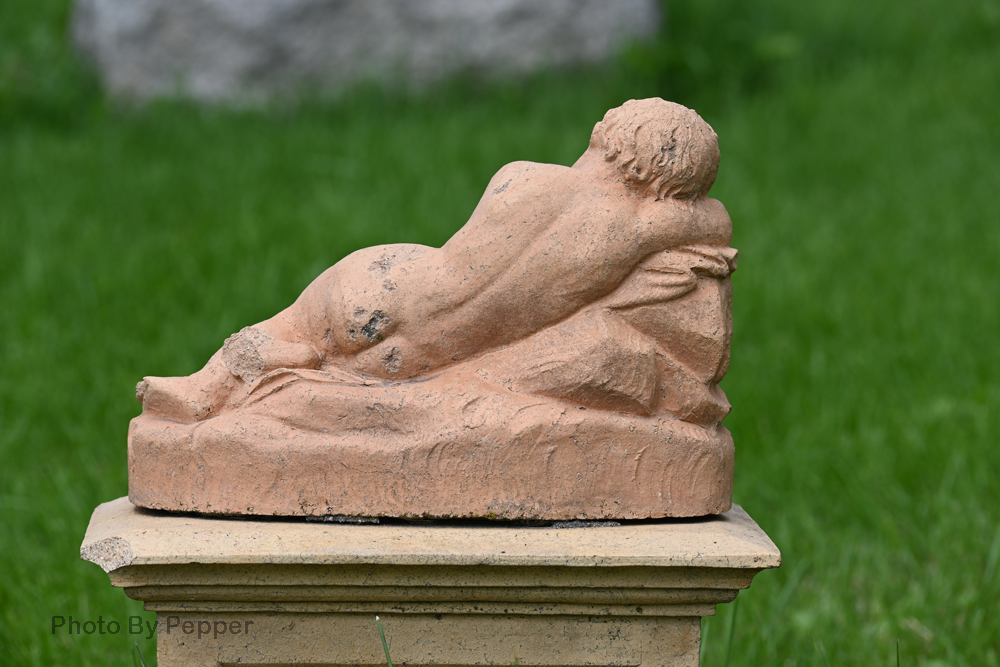
“In one of the stars I shall be living.”
Sunday, December 20, 2020
Friday, December 18, 2020
Jefferson Texas Oakwood Cemetery
“Mourn not my death, but celebrate my life.”
A cloth draped over a column (or an urn) represents the pall – the covering for a coffin in a funeral procession. This is where the expressions "pallbearers" and "cast a pall over…" come from. Represents loss of a family member; the draped column symbolizes mourning of that family member. The draped or broken column also represents the "break" made by the deceased between the living and the dead, i.e., the transition between this world and your heavenly home.
When you see dove depicted on headstones in historic cemeteries, they represent innocence, peace, and/ or the Holy Spirit.
A book found on a cemetery tombstone can represent many different things, including the book of life, often represented as the Bible. A book on a gravestone may also depict learning, a scholar, a prayer, memory, or someone who worked as a writer, bookseller, or publisher. Books and scrolls can also represent the Evangelists.
Angels are believed to be the guardians of mankind and can intercede for assistance from Heaven.
Hands holding an open book (usually a representation of the Bible) symbolize the embodiment of faith. The rose can symbolise the one we have loved and lost and a deep longing. It is the quintessential emblem of earthly love. The Virgin Mary has been nicknamed “Rose”, bringing together both earthly and heavenly grace as well as piercing sorrow.
Angel with Anchor. An anchor is an early Christian symbol of hope and at rest.
A lamb on a headstone often indicates the grave of an infant due to their innocence. as a symbol, lambs represent innocence and sacrifice. The lamb may also be a reference to a passage in the Bible (John 1:29) where John the Baptist calls Jesus, “the Lamb of God who takes away the sin of the world.”
Thursday, December 17, 2020
Diamond Bessie Moore - Jefferson Texas Oakwood Cemetery
“A love, true and constant.”
Diamond Bessie Moore her real name was Annie Stone, who was reputed to have been a famous prostitute, arrived in Jefferson Texas by steamboat in January 1877 with her partner, Abraham Rothschild. Soon after their landing, the attractive, petite woman, who wore lavish dresses and diamond jewelry came to be nicknamed “Diamond Bessie”. Bessie and Abe were last seen walking together across the foot bridge over Big Cypress Bayou, bound for an afternoon picnic, but shortly thereafter, Abe was seen returning alone. A few days later, Bessie’s body was discovered tragically murdered in the woods along the nearby bayou, with all of her jewelry missing. Abe Rothschild was charged with the crime and his trial became one of the most notorious and widely followed court battles of that time period. Rothschild was eventually, although suspiciously, found not guilty.
Grigsby Monument Jefferson Texas
George Marshall Dallas Grigsby 1852–1906
BIRTH 26 MAY 1852 • Boone County, Kentucky, USA
DEATH 30 JUN 1906 • Jefferson, Marion, Texas, USA
Mattie Lee Rowland 1864–1904
BIRTH DECEMBER 1864 • Macon County, Alabama, USA
DEATH 14 NOVEMBER 1904 • Multnomah County, Oregon, USA
Saturday, August 8, 2020
Ault Colorado Cemetery
“Here lies an atheist.
All dressed up with no place to go.”
Joe P Martinez Ault Colorado

Rank and organization: Private, U.S. Army, Company K, 32d Infantry, 7th Infantry Division.
Place and date: On Attu, Aleutians, May 26, 1943.
Entered service at: Ault, Colorado
Birth: Taos, New Mexico
G.O. No.: 71, October 27, 1943.
Citation:
For conspicuous gallantry and intrepidity above and beyond the call of duty in action with the enemy. Over a period of several days, repeated efforts to drive the enemy from a key defensive position high in the snow-covered precipitous mountains between East Arm Holtz Bay and Chichagof Harbor had failed. On 26 May 1943, troop dispositions were readjusted and a trial coordinated attack on this position by a reinforced battalion was launched. Initially successful, the attack hesitated. In the face of severe hostile machine gun, rifle, and mortar fire, Pvt. Martinez, an automatic rifleman, rose to his feet and resumed his advance. Occasionally he stopped to urge his comrades on. His example inspired others to follow. After a most difficult climb, Pvt. Martinez eliminated resistance from part of the enemy position by BAR fire and hand grenades, thus assisting the advance of other attacking elements. This success only partially completed the action. The main Holtz-Chichagof Pass rose about 150 feet higher, flanked by steep rocky ridges and reached by a snow-filled defile. Passage was barred by enemy fire from either flank and from tiers of snow trenches in front. Despite these obstacles, and knowing of their existence, Pvt. Martinez again led the troops on and up, personally silencing several trenches with BAR fire and ultimately reaching the pass itself. Here, just below the knifelike rim of the pass, Pvt. Martinez encountered a final enemy-occupied trench and as he was engaged in firing into it he was mortally wounded. The pass, however, was taken, and its capture was an important preliminary to the end of organized hostile resistance.
Private Joseph P. MartÃnez was the first Hispanic-American and first Coloradan to receive the Medal of Honor during World War II.
MartÃnez was buried with full military honors at Ault Cemetery, Ault, Weld County in Colorado. On April 13, 1945, the United States Navy named one of its ships, which served as a troop transport during the Korean War, the USNS Private Joe P. Martinez. The state of Colorado has honored his memory by naming a street and renaming a former base reception center and early officer's club which currently serves as the service center after him. The government named a Disabled American Veterans chapter in Colorado and an American Legion post in California in his honor. Three statues were erected with his likeness and are located in the Colorado cities of Ault, Greeley at the Weld County Veterans Memorial Park, and Denver. The U.S. Army also named an Army Reserve military installation in Denver, Colorado after Martinez. The 7th Infantry Division honored him by naming the Fort Ord Welcome Center (originally the Post Headquarters built in 1941)Martinez Hall in 1977. Although Fort Ord closed in 1993, Martinez Hall still serves as a Veterans Transition Service Center. The City of Denver has also named a park after Private Martinez, "Joseph P Martinez Park", which is at 900 N Raleigh St, Denver, Colorado.